On thing I have learned over the past 4-5 years working with groups in the social media/digital space: social technologies has provided one heck of a platform for individuals and brands to become overt, expository, and exclamatory in an expedient fashion. Especially when it comes to taking a “stand” or “position” on a topic.
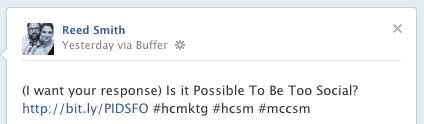
Reed Smith posed this question yesterday on Facebook: “Is it Possible To Be Too Social?”
Now his context for this question was based on frequency…but with the recent barrage of social advocates overloading our walls from politics, healthcare, and even the recent Chick-Fil-A situation; this has me thinking through a different lens.
I am amazed each day what I read on my news feed, on Twitter, the memes that are posted, and how we de-contextualize information to meet our needs. We live in a cut-and-paste, digital recycle world where we take information and reuse to fit our messaging needs.
I often wonder, would the same conversations that happen online happen offline? Would we be more open to conversation offline or would we use the same “hunt and kill” mentality, hiding behind the keyboard, and sharing our inner thoughts like we do online?
There are so many people and individuals that I meet that are nothing like the personalities they portray in the online space. This bi-polar online/offline life we lead leads me to wonder…who am I talking to in person.
Admit it, you have fallen victim to his moment of “rage,” getting caught in the moment wanting to one-up a person online, getting caught in a feud that leads to a Facebook thread three screen shots deep. Before you know it…you wonder who was that person behind that avatar that wrote those rebuttal statements…is that me?
So here is the question, what does it mean to be too social? Is it frequency? Frequency has a lot to do with it…and I do not mean the number of times you communicate a marketing message. I mean the frequency of hours we spend online…developing an online brand that does not coincide with our offline personality.
And we as marketers that manage brand’s appearance online…we end-up having multiple personality disorder. We are typing on our Facebook page, then posting for our brand…hoping that we do not send out that party picture to the wrong social account. Admit it…you have done it before. You just have to know how to delete it REAL FAST.
Are we too “Social”? Well, if it means online…the retail brands hope so, they want your attention and want you to advocate for their cause. I would be willing to bet that Chick-Fil-A is happy with the image above…the 811 comments posted (which leads to shares). But would you say that same thing in person to someone you know that does not agree? With that same expository tone? That same shout with conviction? Would you be proud of that commet after your family members, peers, or even work relationships see that exclamation? Or would wait to get online talk about them later?
What is your ethic and where do you stand online and offline…and are they the same voice? Are we telling the same story? I think we (including myself) need to check ourselves at the door from time to time.
I read all the negative and hateful reaction in the comments section below her article, most of which came from seasoned marketing professionals. Here is the funny thing about her article and premise she provided…all the negative comments reinforced the fact the her generation is pushing the traditional marketing glass ceiling upward so high…it is shattering.
Also…I have lost lots of respect for many of those seasoned professionals that thought it was fun to add their jabs in the commenting section of this article. Especially the ones that called her generation arrogant. Your negativity reinforced her argument and I am saddened that you felt it was fun to join in and take a swing at the punching bag. Especially a generation we need to embrace.
As a regular lecturer working with both undergraduates and graduate students, I am amazed each day how the social space is a second language to not only Generation Y…but also Generation C.
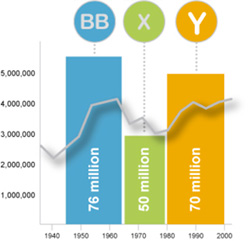
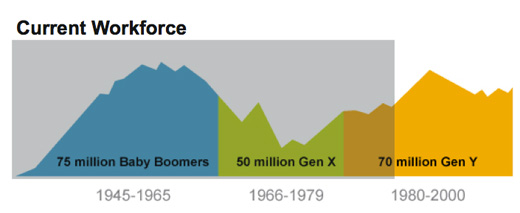
There is a shift happening in the workplace and Generation Y will soon be replacing the Baby Boomers in the workplace…76 million of them. So what about Generation X…they are the current VP’s of Communications and Marketing working for the Baby Boomers…hoping to land those next positions. They do not want to get jumped.
So let’s look at Cathryn and Generation Y.
Generation Y is the fastest growing segment of the workforce, growing from 14% to 21% over the past four years. Most Baby Boomers will phase out of the workforce in the next 10 to 20 years and Generation Y will rapidly assume the place of the Baby Boomers.
The Gen Y experience is centered around a growing, technologically connected society who are not only learning the common discourse of the web…BUT creating their own discourse in the social space. These discourse communities are the ones driving the advertising market space and they are taking a commanding front seat to not only becoming the lead in purchasing power but social influence.
Gen X is stuck in transitioning from device to device because we were the greatest usability test for this technological era. Gen Y is commanding how these devices are created. Actually…some groups like Neilsen consider the 18-34 age range Generation C.
“The latest Census reports that Americans 18-34 make up 23 percent of the U.S. population, yet they represent an outsized portion of consumers watching online video (27%), visiting social networking/blog sites (27%), owning tablets (33%) and using a smartphone (39%). Their ownership and use of connected devices makes them incredibly unique consumers, representing both a challenge and opportunity for marketers and content providers alike. Generation C is engaging in new ways and there are more touch points for marketers to reach them.”
Gen C uses technology as their oxygen where networking online is critical with the need for instant gratification. They are and will be multi-focused in work-life. Technology is completely embedded into their daily life and their physical space and technology are well integrated.
So what does all this mean and what does all this have to do with Cathryn’s premise. Let me tell a story. I taught a Business Writing Class last semester and the final project was to work with a large organization to create and social media strategy for an event promotion. The class was split into groups and competed to create the best strategy.
This large organization had been pitched numerous ideas by from well-respected marketing firms, yet they were still looking for something innovative, fun, and engaging for the community. In one month, these 25 college students created six strategies that not only met the needs of the organization, but provided some amazing insight and innovation. They basically blew the socks off this organization, exceeding expectations of the organization that had already been pitched by well-respected marketing firms. Why? Because they live and breathe the social space…they just had to learn how integrate audience analysis and execution.
The social space is not going anywhere. It is here to stay and the next leaders of this space will be the Cathryns of the world. They are confident in their abilities and have an eagerness to show what they have. They also have something much different…they have the entrepreneurial spirit.
Generation C scares the hell out of us not only because of how smart they are, and how connected they’ve become, and how easily they integrate themselves into this social space… but also how expendable Generation X is in this exponentially evolving American economy.
We need to quit fussing and complaining about Cathryn because we might be answering to her one day… sooner rather than later. I already am. One of my former students is now my client in a large hospital system. I have a pretty good time doing business with her.
It is up to us seasoned professionals to help shaped this generation and learn to leverage their knowledge. We may not like the tone of her article, but we cannot escape her reality.
I ask you…are we truly a divided America? Have we thrown up the ideological lines in the sand? Or do we just have better access to media and technologies that provide an outlet for our voice?
The digital chasm has been crossed with more American’s gaining access to connected technologies. Internet access used to be this “elite” luxury where the only access was in metropolitan areas, large businesses, and large educational institutions. Now, more and more areas have become connected from rural America to other socioeconomic demographics; more Americans can go online to read and react.
So has access to knowledge and information created a divided nation? Has access to social websites and mobile platforms provided a place for too many people to voice their opinions.
I say we are the vocal melting pot with a diverse cultural impact. We come from so many different backgrounds, experiences, cultures, knowledge bases that now we can share in places we once had limited access. The smart phone has transformed the way we communicate where we can share our thoughts in real time. A Google search provides real time results to peoples thoughts, pictures, videos, and all the relevant information that provides context to our culture..
The social search is alive and well and it is this technological breakthrough that provides those with an opinion a platform to share. Whether we agree, disagree, or react; we are not a part of a division…we are a sum of all parts. Social media is now the platform that crosses all socioeconomic backgrounds, a platform for our voice to be heard.
We now have a place to share our story.
Happy Birthday to a nation that provides the liberty and the knowledge that allows us to share the one thing that makes us whole…our voice.
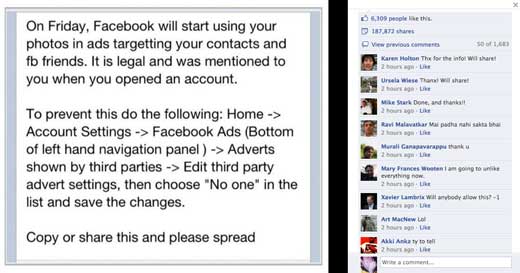
You see this…yes, this is being passed around online. All over Facebook, people are sharing this…FAST. I think this one image has been shared over 187K times, and we are eating it up and sharing it faster than some funny YouTube video. The viral effect of social conspiracy theory has invaded our online space like funny looking martians…and the idea we are being watched by big brother is ALL AROUND.
Guess what…it is not a conspiracy.
Here is another one of my favorites that people are sharing on Facebook:
“PRIVACY NOTICE: Warning – any person and/or institution and/or Agent and/or Agency of any governmental structure including but not limited to the United States Federal Government also using or monitoring/using this website or any of its associated websites, you do NOT have my permission to utilize any of my profile information nor any of the content contained herein including, but not limited to my photos, and/or the comments made about my photos or any other “picture” art posted on my profile.
You are hereby notified that you are strictly prohibited from disclosing, copying, distributing, disseminating, or taking any other action against me with regard to this profile and the contents herein. The foregoing prohibitions also apply to your employee , agent , student or any personnel under your direction or control.
The contents of this profile are private and legally privileged and confidential information, and the violation of my personal privacy is punishable by law. UCC 1-103 1-308 ALL RIGHTS RESERVED WITHOUT PREJUDICE”
People are copying and pasting this into their status’s faster than their internet connection will allow them. WAKE UP AND SMELL THE COFFEE.
This is what I know:
1 – Big brother is watching us –> Google Maps
2 – Facebook is FREE
3 – Facebook is monetizing our data
4 – Twitter is FREE
5 – Twitter is monetizing our data
6 – Google is FREE
7 – Google is monetizing our data
8 – Elvis is STILL ALIVE…maybe?
9 – I just used Google to search “Is Elvis still alive?”
OK…back to the important discussion…
Who the heck are we to use something like Facebook, Twitter, Google and sit back an expect them not to monetize it. When we sign-up, we knowingly accept the fact that we are uploading content, pictures, impressions, etc. and it is going to be used/leveraged to generate their income.
Are we that naive or has Facebook, Twitter, Google, and other online media outlets leveraged the fact that we want more for nothing, while they make it harder for us to opt-out of leveraging our information.
How many people do you know upload all their pictures to Facebook as a primary storage device. Specifically they use Facebook as their photo album. Each picture takes space, it takes bandwidth, it has an ecological impact on our local environments…the data centers that support this information. We as consumers pay NOTHING for this…NOTHING. We are getting so much for NOTHING and yet we expect the businesses who spend billions to support these infrastructures not leverage that information to generate revenue.
When is the last time you gave away all your intellectual power and knowledge for free. Yes, you probably donate your time and energy to certain causes, non-profits, churches, initiatives, etc. But could you do that full time…NO. You have to pay the mortgage, gas, electricity, etc. There is no such thing as a free lunch.
The social documentary is alive and well in the social space(s). So let’s look at the statistics of usage in this free market of online spaces:
Twitter (Stats by Mediabistro.com)
By September 2011, we were tweeting 33 billion tweets per day and 11 Twitter accounts are created every second with 1 million accounts added every day. Guess what…$259 million dollars in projected ad revenue for 2012.
Facebook (Stats by SearchEngineJournal.com)
Let’s look at Facebook…250 million photos uploaded daily with 845 million active users that have led to 100 billion connections. Facebook users average 2.7 billions “Likes” each day, 37 million “Pages” with 10 or more “Likes”, and 20 minutes spent per visit. In 2011, Facebook make $1 Billion dollars with Zynga games accounting for 12% of that total revenue.
Google (Information from StatisticBrain.com and Larry Page’s Blog)
How about Google…last year there were 1.7 Trillion searches with an average of 4.7 billions searches per day. YouTube has over 800 million monthly users uploading over an hour of video per second. Chrome has over 200 million. There are over 350 million people using Gmail and over 5,000 new businesses and educational establishments now sign up every day.
Each day we add to the social conspiracy, we use these outlets to share at the expense of them driving their revenue dollars. Our content, our time and their infrastructure, their revenue. We pay for this service with our content, that is our investment. As an investor, we should openly, knowingly understand how they use our data and use these networks appropriately.
The conspiracy theory is true…they are using our time, energy, content, and effort to generate billions. Just quit freaking out about it and know what you are paying for…each second and each time you use these outlets.
I am continuing my thought process surrounding how we as organizations/businesses have to own our media. But this takes on a fundamental thought process and radical shift in how we do business…we have to truly own our media by building our team.
For so many years…large organizations have allowed agencies and firms to own the “brand’s” message. They were tasked and empowered to do the brand research, create the strategy, build the message, construct the media, distribute the media, and track the results. As we move into the digital world, ownership of media assets is coming more and more key to the success of organizations. This is from ownership of URL’s (domains), website access, video content, and now social media ownership.
I have always advocated that organizations and business should take an ownership role in owning their media and communications. They should not be restricted by third party vendors how to access the online tools that support their brand. This goes all the way down to who owns the right to update social outlets, who can change the website copy, share a Twitter update, create a video message. Organizations (specifically brands) should own their media and how they share this message…but to support this philosophy, their has to be a staff in place to push this philosophy forward.
Large organizations like hospitals and higher education institutions are battling this issue. Who creates the Facebook updates, Twitter updates, video messages, blog posts, etc. Should it be the people that work inside the brand or the vendors that support the brand. I think the vendors should help brands create a strategy and create workflows for organizations to own their branded message and build a community.
1) You have to have a new media/social staff in place. These people inside your organization have to be able to not only understand the marketing/pr initiatives but also be able to have the skills to design, develop, implement, and share the content created. They have to be the ultimate brand ambassadors who not only help create the community…*but* empower others in the organization to share the message. A Community Manager is a good place to begin but you also need: – New media staff that can create and update web properties (from design to programming). – Video professional(s) that can create video messages and manage video content managements systems like YouTube, Vimeo, and other private portals.
– Creative writers who not only can create copy for online properties, but help write scripts for video content.
2) Create an advisory team to support the organization. Hospitals are a prime example of this silo based organization. As a consultant, I spend more time working with service lines and departments that are creating social/web portals that do not meet the organization’s goals. This advisory team empowers, educates, and helps implement organization strategy so the online properties are successful. This team can be made up of representatives across the organization that directly interface with the part of the organization that manages these online spaces. Let them be a part of the strategy help empower them to build the community.
3) Have an senior new/social media team in place that builds community strategy goals and initiatives. This team is a part of the visual branding process and also implements strategies to track success for this online properties.
Owning our media has become ever important, one that is harder now is to wrangle a team together. So many times I walk into an organization and I ask, who updates your website, your Facebook page(s), domains, etc. How can we control our message and be a part of the community when we do not even have controlling access to our digital properties. The organization many times knows their brand message the best…why not empower the branded organization own the process, the media that is shared.
It has been one of those days where something un-expectantly happened…something that has not happened in a long time. As I was working on some emails, I received a note from a client. Steve Mudge of Serrus Capital Partners sent me an email congratulating me for being awarded SCPRSA’s Inaugural Jupiter Award.
I was thinking, how the heck did he find out…the awards ceremony was just last Thursday evening. He sent me a link from an email newsletter he receives daily from Midlandbiz.com with my picture at the top. It has been a while since I did the awards thing…so long, that I actually forgot what is was all about.
Back in my television days, I was a member of the National Academy of Television Arts and Sciences (NATAS) and numerous other organizations that hand out awards for broadcast television excellence. I have been a part of the judging committees for numerous regions including the Carolinas and the West Coast. It was a part of my culture every year to submit for awards…basically taking the time to pick my best work, fill out the applications, pay hundreds and hundreds of dollars, and sit back and wait.
I have been on numerous judging committees across the country and was even the person that put together all the television station’s entries, making sure everything is edited correctly, applications were correct, the right amount of money was included, the correct categories corresponded with the entries, and so on. It was a part of my television culture… at-least I was a part of this television culture of competition.
I was even a part of the competitive culture that work harder on stories that we knew had a tremendous opportunity to win awards. It was a part of that competitive culture of validation. The trophy case led to bigger jobs, promotions, bigger raises, bigger projects…and ultimately the ego boost.
Over the years, I have been awarded numerous regional Emmy awards, AP Awards, NPPA Awards, and many other awards across numerous organizations. I have won international competitions as an academic and presented at numerous conferences to share research from my graduate school days. But none of this compared to what happened last week…nothing.
Fast forward to Thursday’s event at Columbia’s Springdale House and Gardens. What an evening. It started out like most awards ceremonies, passing out statues for hard work. Each award probably had numerous applicants competing, sharing their best work from the past year. Sarah and I sat at Greenville Hospital System’s table with Karen Potter and Patti Smoake among many others. The anticipation was rising.
When it was time for the individual awards, I thought I was going to be asked to stand to be honored. Not the case…I sat an listened to a long write-up about me. First of all, this is the first time I have ever heard someone share this much about me in such a public forum, among so many distinguished guests. The more that was read, the more I was unsure what to do…I was humbled.
It is one thing to spend a whole year working to do you best work, then compile it all together with application fees and persuasive write-ups to encourage the judges to choose you. But is it another thing to have someone (a friend, colleague, and client) take the time to write something special and submit for an award. I had no idea what was written. I had no idea I was chosen. I had no idea.
The Jupiter Award “was presented to three individuals for exceptional contributions to the use of social media as a communications tool. SCPRSA presented three awards in this category, representing each of the chapter’s regions.” As a former broadcast journalist, my career was surrounded professionally telling stories for television. Now, my business helps organizations use social and digital media to tell stories. Now that I am no longer in the broadcast industry and work for myself, this award is pure validation. A sense of validation for me and my business. I am humbled!
Here is the article from Midlandbiz.com – CLICK HERE
Here is the press release from SCPRSA – CLICK HERE
Here is a link to SCPRSA’s website – CLICK HERE
Where are the leaders? where are they and where are they pushing this social/digital space forward?
There is a big conversation happening right now and it is repeatable…so repeatable. We are just repeating the same stuff over and over and over again. We have a few innovators in this digital/social space and they have done a great job monetizing…monetizing the paradigm of followers.
I have to admit, I blame twitter and the “UI” they created with twitter. The idea of “follower” has permeated the social space. There were and still are so many leaders who embarked on a journey of how to use the space…to build their business. And yes, they gained a hell of a lot of followers and now they are repurposing their blog for books. The best part…they are still talking about the same stuff since the early craze of the social space. The same stuff over and over, no new innovative thinking.
We are still following, retweetting, and resharing the same information and it has a velocity of epic proportion…this velocity is not creating new thought leadership and new innovative concepts. This following, retweeting, and resharing is filling their pocket books and limiting the innovation need to push this space forward. So why are we still depending on yesterday’s innovators for tomorrows wave of new thought leadership?
Conference after conference I attend…we are still having the same conversation…so where are the new wave of social innovators. Who is pushing the envelop? Who is pushing the space and proving that they can build communities and make money.
I think the innovators are the ones that are not the social/digital consultants…they are the real business people who have figured out how to use these tools and are now leveraging these spaces to solve their business problems. And guess what…they are not using the conversation of fear…they are creating and innovating. They are creating great content, solving big problems, and using social/digital tools that we share, retweet, pin, and leverage.
So…where are you innovators. You need to be leading these conferences and teach us consultants a thing or two. Why, because you are the innovators, creating new communities, solving problems (your problems) because you are owning your content.
It is all about owning your content and innovating yourself. We consultants are leveraging your case-study to share with the world to act smart, but you are the smart ones. Owning content is fun because it your tangible result, and you are obtaining a return the metric you have figured out.
I have thought about it over and over again. If i was to build a social/digital conference…I would not let one single social/digital consultant speak or share a presentation. I would bring real practitioners to the table, from different industries, and let them show us how they built “THEIR” communities. Why…they have owned their content and learned how to monetize their work.
If you are a small entrepreneurial business or organization, you know you have had to keep a tight lip when raising equity. Specifically, you have had to remove any conversation of raising money in your social/digital spaces, especially when comes to soliciting funds. This makes it extremely hard for organizations that are trying to grow their business, restricting them from talking about a major focus of the organization.
For the last year, I have been working with Serrus Capital Partners with their digital/social efforts. Serrus is real estate investment firm not only raising capital for specific funds but using those funds to purchase distressed properties as investment properties. These properties are then refurbished, revitalized, and given a tremendous facelift and structure upgrade. They have to raise capital to fullfil their business model, yet cannot “talk” or solicit online via social outlets. This would be securities violation and ultimately breaking the law.
Our blogging and social efforts have been focused solely on raising awareness. The blog has been focused on topics like leadership and entrepreneurship. Video content has been created for YouTube to share the mission of the organization and communicating goodwill. Twitter and Facebook are used as channels to share this content. We have been telling stories of people that have been helped with affordable housing, contractors who have been put back to work, and communities/sub-divisions that now have properties that meet or exceed the surrounding property values.
We cannot talk about money. We cannot mention investing in the fund. We cannot share financial information unless numerous attorneys scrub through the content. Sometimes this content that was time specific misses window(s) of opportunity.
“With ‘crowd funding,’ startups would be able to more easily seek equity investors in places like Facebook. And most of the people, believes the real advantage comes in the freedom to use social media to attract investment. The beauty of crowd funding is it can provide you with a very diverse and passionate group of funders who are putting money into your company because they truly believe in what you’re doing and support you even though they’re not accredited investors. “
“The legislation will enable small businesses to use the Internet to raise up to $1 million in small investments from lots of people, a technique known as crowdfunding. It also will encourage more companies to go public by exempting them from some Securities and Exchange Commission regulations in the first five years after an initial public offering.”
The article also stated, “House Majority Leader Eric Cantor said the legislation ‘will increase capital formation and pave the way for more small-scale businesses to go public and create jobs.'”
Basically, “The new law would largely lift those barriers, allowing companies to raise up to $1 million in equity capital from an unlimited number of investors, while allowing the offering to be marketed widely, including on social networks or crowd-funding sites like Kickstarter.”
Many individuals in small business or entrepreneurial communities leverage their online communities to build their contact lists, communicate, market products or services, or connect with new business opportunities. Many of these individuals have built large online communities yet cannot leverage the technology to share their passion, especially when it comes to raising funds.
On April 5, 2012…President Obama signed the Jobs Act which included “Crowdfunding” in the bill. Mashable.com reports “The bill classifies startups as ’emerging growth companies’ that can turn to online investors to raise much-sought-after startup capital — similar to how websites such as Kickstarter let users raise money for films, books or other projects.”
It was also reported in this Mashable.com article, “In the amended bill, the Senate gave the U.S. Securities and Exchange Commission 270 days to interpret and issue the rules for the public. That means potential investors may have to wait until 2013 before it’s legal to make an investment. In the meantime, there are a few things they should consider.
In about 90 days the Access to Capital for Jobs Creators Act should go into effect, allowing companies to tell the public that they are raising capital. In the past, this type of solicitation was illegal and could exempt the company from raising money privately. Now, startups should be able to solicit their deal, which could mean that more investors will be able to hear about it.”
This is a game changer for many organizations in how they can communicate when raising capital. “The caveat is that only accredited investors can participate in those deals where the company is soliciting. In other words, this will only apply to investors who fall into the following categories.
1) Your net worth is more than $1 million, excluding your home 2) You have $200,000 in new income for the last two years and a reasonable expectation to make $200,000 in the current year 3) You have $300,000 in household income for the last two years and a reasonable expectation to make $300,000 in the current year.”
Now, how will this effect groups like Serrus? Not sure yet, we are in the middle of that period when the U.S. Securities and Exchange Commission has 270 days to interpret. At the same time, many organizations are engaging their legal counsel to see how it will impact their current solicitation models. From a social/digital perspective…the needle is moving.
So how do you plan over the next 270 days in anticipation of the new rules and regulations, it is the time to continue to build your online communities?
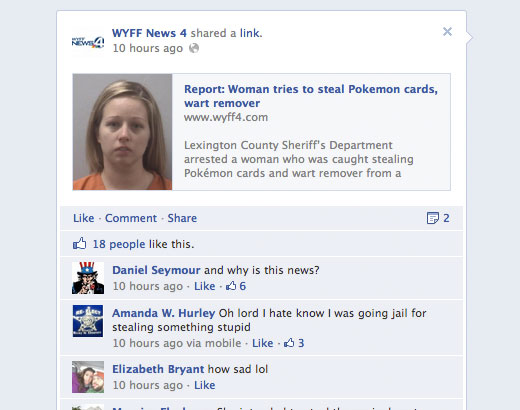
The debate is heated and has been heated for years…how does the social space play inside the journalistic space. This morning the above status updated came across my newsfeed inside Facebook. So here is the story or “news” that was reported via WYFF.com:
“Deputies say a security officer inside the store noticed Ariail trying to leave the store without paying for items. Some of the items included a youth cup, Pokémon cards, a box of hair color and two bottles of wart remover.”
I immediately began to question why is this “news” and why this story warrants this report on Facebook? Gigaom.com posted an article surrounding this issue “So can we stop talking about bloggers vs. journalists now?” In this article they look about HuffingtonPost.com, who just received a Pulitzer Prize, they look at how this “social outlet” created it’s broad reach.
“Did the Huffington Post leverage its web speed and broad reach, including traffic-driving features such as slideshows of swimsuit models and aggregated posts based on stories written by other media outlets, to build the foundation that allowed it to add those traditional journalistic elements? Of course it did, just as many newspapers have. In fact, the history of newspapering — and particularly pioneers like William Randolph Hearst — reads a lot like the rise of the Huffington Post and Buzzfeed and other entities, except with paper instead of bits.”
So is the Facebook status update from WYFF.com “news” or even “journalism”? Or is just content provided to merely drive traffic? And does this have a place in the journalistic space?
So back to my original thought…when I first noticed the status update, I was honestly sad for the woman. I immediately assumed she was a mother who was probably trying to find a toy for her child and another few items, and did not have the funds to pay for the items. I had many questions, areas where I would want to research to find more answers.
1) Is she a mother?
2) Does she have a job?
3) What was her prior arrest?
4) What makes stealing Pokemon cards so compelling?
5) Is she a product of the social/economic time where it is hard to find a job w/o good skills?
6) What are the petty theft rates in South Carolina in the past few years given the recent unemployment rates?
7) What is the larger story?
These questions led me to wonder why WYFF.com feels compelled to update Facebook with something that I feel makes a marginal case as “news” or even “journalism”?
So Let’s define our terms:
1) News:
– Newly received or noteworthy information, esp. about recent or important events.
– A broadcast or published report of news.
2) Journalism
-The activity or profession of writing for newspapers or magazines or of broadcasting news on radio or television.
-The product of such activity.
Ok, based on these definitions from Definitions.com, maybe it can be considered news…but journalism? Let’s see what the University of Missouri’s Journalism School defines as journalism. I found Walter William’s Journalistic Creed:
“I believe that the journalism which succeeds best—and best deserves success—fears God and honors Man; is stoutly independent, unmoved by pride of opinion or greed of power,constructive, tolerant but never careless, self-controlled, patient, always respectful of its readers but always unafraid, is quickly indignant at injustice; is unswayed by the appeal of privilege or the clamor of the mob; seeks to give every man a chance and, as far as law and honest wage and recognition of human brotherhood can make it so, an equal chance; is profoundly patriotic while sincerely promoting international good will and cementing world-comradeship; is a journalism of humanity, of and for today’s world.”
This definition led me to a a conversation between Reynolds Journalism Institute Fellow Mike Fancher and students at the Missouri School of Journalism who tackle this question…they are trying to define the meaning of journalism:
“The concept of “conversation” may be perceived as part of accessibility. You’re no longer “looking down” upon your reader, or your audience, or citizens. You’re collaborating with them in the news process.”
Let’s go back to the Facebook status update, as of 6:30pm on 4/19/12, there were 44 comments. This status update created a conversation between WYFF.com and the “audience.”
“According to recent data, newspapers have just a single percentage point lead on social media as a source of reportage, with Facebook (59.5 percent), Twitter (19.9 percent) and YouTube (12.7 percent) leading the charge. Since 2009, traffic to news sites from social media channels has increased dramatically, and some 57 percent of adults who consume news via a digital device predominately use Facebook and Twitter.
Of course, journalism isn’t actually going away – it’s simply the medium that is changing. While social media empowers all of us to be the source, and to break the story, there will always be a high demand for quality reporting. But the way in which we digest that information is rapidly changing – and in this writer’s opinion, very much for the better.”
So are the lines between “old” and “new” media beginning to blur and converge more and more everyday? Social outlets like blogs are playing a huge role in how news outlets are engaging audiences, with more editorialized content.
“And while the Huffington Post has been getting more and more newspaper-like, entities such as the New York Times have been getting more blog-like: the relaunch of the medical section of the paper’s website, called Well, is just the latest in a series of similar relaunches that have turned sections of the NYT into blog-style portals.”
So is this status update news? Based on the definition above…Yes. Is this status update journalism? Some say yes and some say no. I say, where are the journalists at WYFF.com? Why are they not taking this simple status update, one that is being used as traffic drivers for content exploration, and take part in a little “investigative journalism.” Why not dig deeper into this story and use this content driver to a bigger story, the real heart of this story?
Or…should we just accept it at face value. It is not news, not journalism, and media outlets will always integrate content like this to generate clicks, driving traffic to the news they are covering. This type of sensationalized content is at the heart of the social metric of major news outlets. Because clicks leads to ad revenues.
So…let’s just accept in the journalistic space, there is a business side to the purest approach of reporting the news.
——- Links and referenced articles used in this post:
We are trying so hard…so hard to find a way to cram all of our short lived pre-conceived notions into this perplexing visual space. Pinterest intrigues us, fascinates us, and allows us to touch the visual cues that we once allowed technology to overshadow.
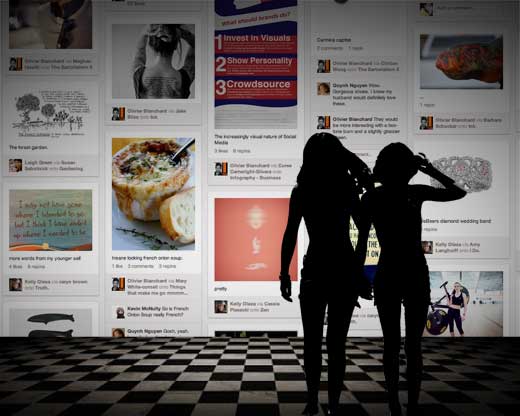
Have you walked through an art gallery, finding yourself lost in a see of visual stories positioned vertically and horizontally for you to ponder. Have you found yourself in this art gallery stopping to gaze and then find yourself conversing with another on-looker.
What makes us vertically scroll the horizontally decked board of visual cues that we call Pinterest. What makes us stop and look a little longer at someone’s daily art? What makes us want to engage a new set of friends that allow us to connect in a different language.
Pictures have a special place is our visual hearts…to explore, share, and gaze. They allow us to dream, cry, laugh, wonder, and explore just a little bit.
“At its best, art deco represented elegance, glamour, functionality and modernity…Although many design movements have political or philosophical beginnings or intentions, art deco was purely decorative.”
Yes…I would have to agree. Now, this is a romantic view of this new social technology…one that has spread across the social space like a fire storm. It has made us wonder why it is now the third largest social network. It has also made us wonder how it creates such rich SEO and digital connection for blogs and online retail outlets. It also makes us wonder if the marketers are going to take the art deco out of the visual exploration.
I don’t know about you, but I have chosen carefully this time. I have chosen which boards to follow, which person to follow, and eagerly un-follow people that do not bring something interesting, innovative, and new to my stream of images. Pintest has become for me the art deco of the social space. My Pinterest stream is one of “elegance, glamour, functionality, and modernity.”
As I sit in marketing meetings, discussion strategy after strategy how to leverage this explosion of paint and color dominated by female artists…I wonder if Pinterest can be quantified.
Well…this is what I know if we marketers are going to try to figure out this social canvas.
1) Users communicate strictly through visual cues. Yes…we find an image to save or share and we pin it to a board that fits the respective category. From birthday wishes, favorite Porsche’s, most intriguing tattoos, cake decorations, and even decorations for that new room…we have visual categories to segment these images. Each image that inspires us might inspire others to think, ponder, share, re-pin, or even comment. What we might interpret and categorize a 356 Bathtub Porsche as “Vintage Cars”…that image might also be re-pinned and categorized as the “Childhood Memories.” We communicate through visual cues…cues that spark emotion and memories.
2) You cannot use the same social strategy used with other social outlets. Pinterest has another human emotion built upon those visual connections of emotions. They say a picture is worth a 1000 words, well each image encompasses those words and releases us from the burden to explain it other than just pinning it.
3) Think visually and imagine how people would share art. If you are really trying to figure out to leverage Pinterest in your social strategy…you have to think beyond the digital connections. You have to think past the how to get people to click and find your contest or campaign. You have to think…what images are going to inspire people to stop and look for just a bit. What will make someone stop scrolling and look at the visual image you posted. What does that image communicate and how will it inspire them to take the next step.
4) Are you marketing or are you inspiring people to think visually. Think of your favorite photos, images, drawings, fonts, colors…what makes you stop and take notice. How can you design visual content so it can be pinned to connect with individuals in a different way. If you are a realtor, why just post pictures of a house…that is why you have MLS and your home website. Why not post pictures of those homes that inspires those buyers to see a residence as his/her residence (well mainly her residence). What visual details about that house will inspire someone to take notice and click. Think…it is more that a shot of the master bedroom or bath, how about shots of fixtures and moldings that represent the construction detail.